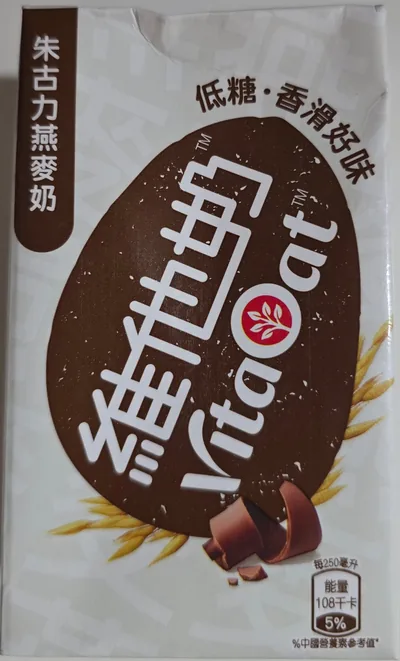
Chocolate Oat Milk
Size not provided
| Item | per 100 g | NRV% |
|---|---|---|
| Energy | 43 kcal (180 kJ) | 2% |
| Protein | 0.7 g | 1% |
| Fat | 0.9 g | 2% |
| Carbohydrate | Not provided | |
| of which sugars | 5.0 g | |
| Sodium | 85 mg | 4% |
| Caffeine | Not provided |
Energy in kJ is converted from kcal at 1 kcal = 4.184 kJ. NRV% is calculated against the GB 28050 NRVs, only where the value is known.
Ingredients
、(4.8%)、、、、、、、穩定劑(、及)、、 酸度調節劑()、乳化劑()。 含有麩質的穀類。 生產此食品的廠房亦處理大豆、奶類、木本堅果、 花生製品及芝麻製品。
Added sugar
English ingredient text (from Open Food Facts)
Water, Oat Powder (4.8%), Sugar, Cocoa Powder, Malt Extract, Tricalcium Phosphate, Rapeseed Oil, Flavouring, Stabilizer (460, 466 and 418), Salt, Acidity Regulator (340), Emulsifier (471). Contains Cereals Containing Gluten. Produced in a factory where soyabeans, milk, tree nuts, peanut products and sesame products are also handled.
Detection is based only on the text provided and is not a full compositional analysis.
Ingredient guide
14/15 ingredients explainedSugar
When an ingredient list says only “sugar”, it means edible sugar used for sweetness without specifying the type (commonly sucrose).
Sugar and caloriesAdded sugar, about 4 kcal/g; raises blood glucose.
Malt extract
Obtained by extracting and concentrating sprouted barley. It contains sugars such as maltose and provides malty flavour and sweetness.
Sugar and caloriesContains sugars such as maltose; raises blood glucose.
Mono- and diglycerides of fatty acids
Emulsifiers made by esterifying fatty acids with glycerol. They mix oil and water evenly, create a smooth mouthfeel and reduce separation.
Sugar and caloriesContains no sugar; a fat-like substance used in very small amounts.
Code: INS 471 / E471 Wikipedia: Mono- and diglycerides of fatty acids
Celluloses (E460)
Cellulose from plant cell walls and its processed forms (microcrystalline cellulose 460i and powdered cellulose 460ii), used as stabilisers in drinks. An ingredient list that says only “460” does not specify the type.
Sugar and caloriesContains no sugar, is barely digested or absorbed by the body, and is used in very small amounts.
Code: INS 460 / E460 Chinese Wikipedia: 纤维素
Sodium carboxymethyl cellulose
A derivative obtained by carboxymethylating cellulose, used for thickening and stabilising. It makes drinks thicker and smoother and keeps particles more evenly suspended.
Sugar and caloriesContains no sugar, is barely digested or absorbed by the body, and is used in very small amounts.
Code: INS 466 / E466 Wikipedia: Carboxymethyl cellulose
Gellan gum
A polysaccharide produced by microbial fermentation. Very small amounts form weak gels that suspend fruit pieces, proteins and other particles in drinks without settling.
Sugar and caloriesContains no sugar, is barely digested or absorbed by the body, and is used in very small amounts.
Code: INS 418 / E418 Chinese Wikipedia: 結蘭膠
Potassium phosphates (INS 340)
A collective name for monopotassium phosphate, dipotassium phosphate and other potassium phosphates, used as buffers and acidity regulators. An ingredient list that says only “340” does not specify the salt.
Sugar and caloriesContains no sugar; contains potassium, and is used in very small amounts.
Code: INS 340 / E340 Wikipedia: Potassium phosphate
Flavourings
Substances that give drinks aroma and taste or enhance them. They may be naturally sourced or synthetic; specific formulations are usually not publicly disclosed.
Sugar and caloriesFlavourings are used in very small amounts and generally do not contribute sugar or calories.
Tricalcium phosphate
A calcium salt of phosphoric acid, often added to plant milks for calcium. It also has anti-caking and stabilising effects.
Sugar and caloriesContains no sugar; used in very small amounts.
Code: INS 341(iii) / E341(iii) Chinese Wikipedia: 磷酸钙
Salt
Consists mainly of sodium chloride, used to season drinks or supply electrolytes, contributing sodium.
Sugar and caloriesContains no sugar; contains sodium.
Water
The main component of drinks. Mineral water comes from underground sources and contains natural minerals.
Sugar and caloriesContains no sugar and provides no calories.
Oats
The main ingredient in oat drinks, ground into flour and treated with water and enzymes to make a drink. They contain dietary fibre (β-glucan). People with allergies to gluten-containing cereals or coeliac disease should check the label.
Sugar and caloriesContains starch. Oat drinks often undergo enzymatic treatment that produces maltose and other sugars; check the nutrition information.
Cocoa powder
Powder made by grinding cocoa beans, providing chocolate flavour and containing small amounts of caffeine and theobromine.
Sugar and caloriesCocoa powder itself contains small amounts of natural sugars and is generally not sweet; check the nutrition information.
Vegetable oil
Plant oils such as rapeseed, soybean and coconut oil provide fat and a smooth mouthfeel in plant milks and milk tea.
Sugar and caloriesContains no sugar; provides calories from fat (about 9 kcal/g).
Explanations are for reference and compiled from public information; the product label takes precedence. View the full ingredient dictionary
How this was determined
| Where sold | Hong Kong |
|---|---|
| Brand basis | Brand field in source |
| Data completeness | 3/3 (ingredients, nutrition, sugar) |
| Sugar-free basis | Not confirmed sugar-free |
| Caffeine | Data missing (Data missing) |
| Sweeteners detected | None detected |
| Sugars detected | None detected |
Nutrition may differ between sizes and recipes.
Data source
| Source | Open Food Facts |
|---|---|
| Note | Community-contributed and possibly incomplete; check the physical label. |
| Date accessed | 2026-11-16 |